Geometric Inputs
The following start part image provides an overview of the relevant, user-supplied, geometric values.
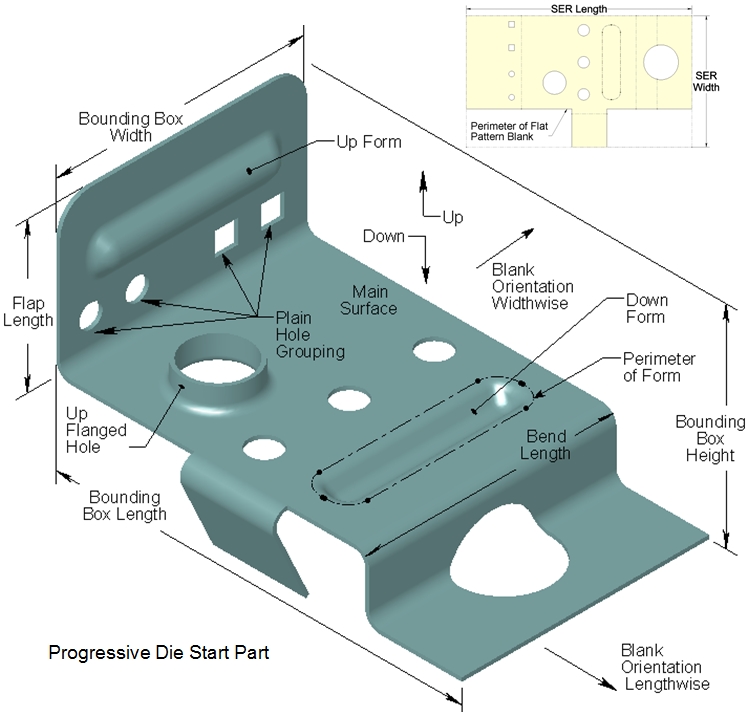
Follow these guidelines to ensure that your part will cost:
-
Create a virtual part and use the settings from an approriate start part (select or search for the start part scenario from the Recently Used Settings menu of the Cost Guide’s Production Scenario tab; see Using Settings from a Start Part).
-
Open the User Guided node in the Process and Machine Options tab of the Cost Guide. Supply a nonzero value for the required PSO Part Volume.
-
Open the Sheet Metal PG node in the Process and Machine Options tab of the Cost Guide. Supply a nonzero value for all the following required PSOs:
-
Width of the flat pattern’s Smallest Enclosing Rectangle
Ensure that Length of the flat pattern’s Smallest Enclosing Rectangle is greater than or equal to Width of the flat pattern’s Smallest Enclosing Rectangle.
-
-
If your routing includes surface treatment or other secondary processes, supply nonzero values for all the following PSOs (the Sheet Metal PG node):
-
Height of the finished part’s Bounding Box
Ensure that Length of the finished part’s Bounding Box is greater than or equal to Width of the finished part’s Bounding Box, and that Width of the finished part’s Bounding Box is greater than or equal to Height of the finished part’s Bounding Box.
-
-
If your routing includes surface treatment, supply a non-zero value for the PSO Part Surface Area (in the Sheet Metal PG node).
-
Open the Progressive Die Routing node. Supply a non-zero value for Perimeter of flat pattern blank. Supply a value for all the other required PSOs; if you or your start part supplies a value greater than 0, also supply consistent values for the associated, conditionally required PSOs. Each required PSO’s associated conditionally required PSOs are listed below, together with their consistency requirements.
-
Open the Progressive Die node. If you or your atrt part supplies values for the optional PSOs Number of Flanged or Countersunk Holes or Number of Deep Draw Forms, also supply consistent values for the associated, conditionally required PSOs. For these two optional PSOs, the associated conditionally required PSOs are listed below, together with their consistency requirements.
The following table lists the Progressive Die Routing node required PSO’s. Any associated conditionally required PSOs are shown together with their consistency requirements:
|
Progressive Die Routing node Required PSO |
Associated Conditionally Required PSO |
|---|---|
|
None |
|
|
Ensure that total perimeter is nonzero and that the number of UP and DOWN bends sums to Number of Bends. |
|
|
Ensure that total perimeter is nonzero and that the number of UP and DOWN forms sums to Number of Forms. |
The following table lists the Progressive Die node optional PSOs that have associated conditionally required PSOs. The associated conditionally required PSOs are shown together with their consistency requirements:
|
Progressive Die node Optional PSO |
Associated Conditionally Required PSOs |
|---|---|
|
Ensure that these values sum to Number of Flanged or Countersunk Holes. |
|
|
Ensure that this value is greater than 0. |
The Progressive Die node has several other important geometric PSOs. All the geometric PSOs are described in detail in the following sections:
Non-geometric PSOs are described in Additional User Inputs.